4DDiG Partition Manager Free Download – Manage Disk Partitions and Clone Drives
Introduction
Managing disk space is an important part of maintaining a Windows computer. As storage devices become larger and users install more applications, save additional files, and upgrade their hardware, organizing disk partitions can become increasingly important. A reliable partition management utility can make these tasks easier while helping users maintain an organized storage system.
4DDiG Partition Manager is a Windows disk management application developed by Tenorshare. It is designed to help users manage partitions, work with storage devices, clone disks, and perform supported Windows migration operations. Its graphical interface provides a more accessible way to handle certain storage-management tasks compared with relying entirely on command-line utilities.
Whether you want to reorganize your hard drive, upgrade from an HDD to an SSD, or manage existing partitions, this software offers several tools worth exploring.
If you are searching for 4DDiG Partition Manager free download, this guide covers its main features, benefits, system requirements, installation process, practical uses, alternatives, and licensing considerations.
What Is 4DDiG Partition Manager?
4DDiG Partition Manager is a disk and partition management utility created by Tenorshare. It is intended to help Windows users organize storage devices and perform selected disk operations through a graphical interface.
Disk partitions divide a physical storage device into separate logical sections. For example, a computer may use one partition for Windows and applications and another for personal files. Proper partition organization can make storage management more convenient.
The software provides tools for working with partitions and disks, including supported resizing, cloning, and operating-system migration operations. The exact capabilities depend on the installed edition and version.
It can be useful for everyday computer users, technicians, and people preparing to upgrade their storage hardware.
Key Features of 4DDiG Partition Manager
1. Disk and Partition Management
One of the main purposes of 4DDiG Partition Manager is to provide tools for managing disk partitions.
Depending on the selected edition, users may be able to create, delete, format, and organize partitions. These operations help users arrange available storage space according to their requirements.
For example, someone with a large storage drive may want to separate personal documents from the Windows installation. Partition management tools can help organize the available capacity into more convenient sections.
Users should always verify the selected disk and partition before applying changes because formatting, deleting, or modifying partitions can cause data loss.
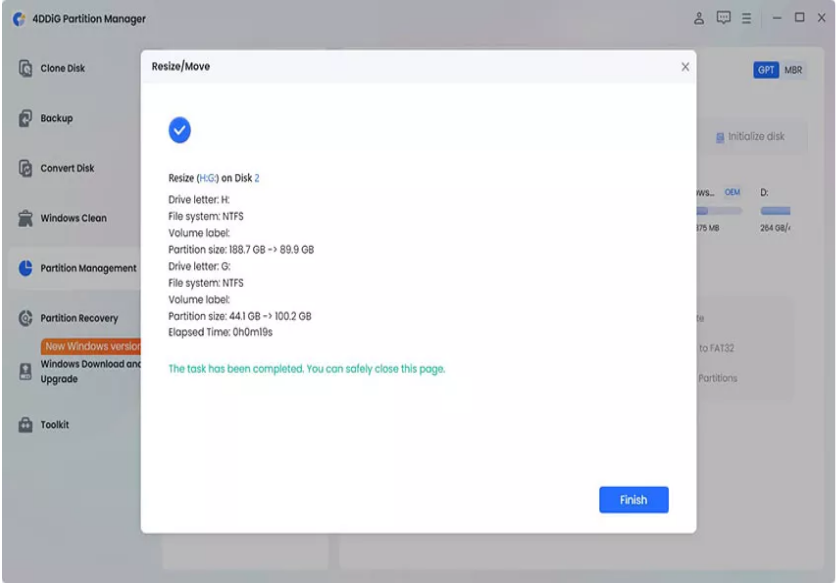
2. Resize and Move Partitions
Partition resizing is useful when one section of a storage device has insufficient space while another has unused capacity.
A partition manager can help users adjust partition sizes when the disk layout and available free space permit it.
Moving or resizing partitions can be useful when reorganizing a Windows computer or preparing a storage device for a different purpose.
Before making changes, check the available space, partition layout, and any restrictions that may apply to the selected operation.
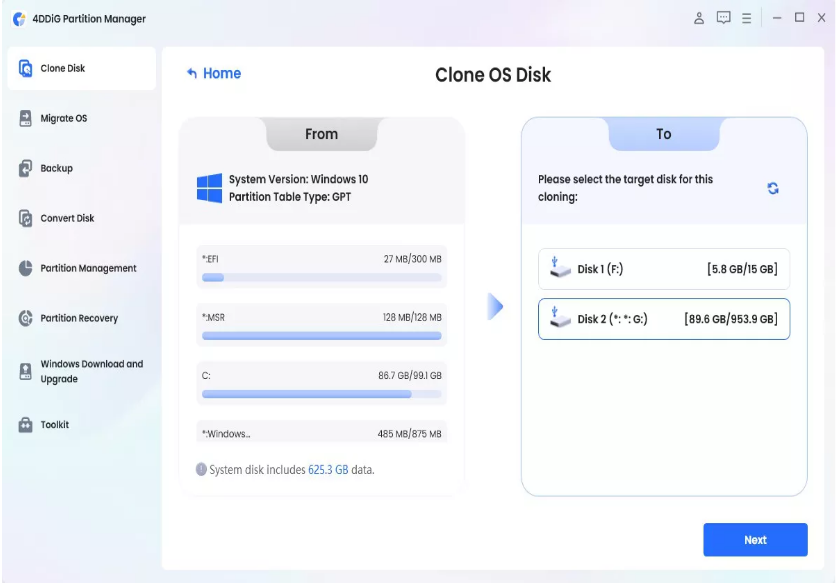
3. Disk Cloning
Disk cloning is an important feature for users who want to move their data from one storage device to another.
For example, someone replacing an older hard drive with a faster SSD may want to copy the existing disk contents rather than reinstalling everything manually.
A cloning utility can help transfer supported partitions and data to another drive. The process may be useful for:
Upgrading from an HDD to an SSD.
Replacing an aging storage device.
Moving data to a larger drive.
Preparing a replacement disk.
Creating a copy of an existing storage layout.
Successful cloning depends on the destination drive's capacity, disk condition, partition layout, and software compatibility.
Always maintain a separate backup of important files before starting a cloning operation.
4. Windows Migration to SSD
Moving Windows to an SSD is a popular hardware upgrade because solid-state drives can offer faster storage performance than traditional mechanical hard drives.
4DDiG Partition Manager provides Windows migration functionality in supported editions. This can help users transfer their operating system to another compatible storage device.
The process may be useful when:
Replacing an older HDD.
Installing a larger SSD.
Upgrading a computer's storage.
Moving an existing Windows installation to another drive.
Before beginning, check the target drive's capacity, compatibility, and connection. Users should also confirm that the computer's firmware and boot configuration support the planned migration.
5. MBR and GPT Disk Conversion
MBR and GPT are two partition styles used to organize storage devices.
MBR (Master Boot Record) is an older partitioning standard that has certain limitations, including restrictions on disk capacity and partition arrangements.
GPT (GUID Partition Table) is a newer partitioning standard commonly used with modern computers and UEFI-based boot configurations.
Conversion between partition styles can be useful when preparing a disk for a different system configuration. However, compatibility and data-preservation conditions vary depending on the conversion method and disk layout.
Before converting a disk, verify the software's supported procedure and back up important information.
6. Storage Device Management
A disk management application can help users review their storage configuration and identify the partitions available on connected drives.
This is useful when working with multiple internal drives, external storage devices, or a newly installed SSD.
Users should check that the correct disk is selected before performing any operation. Confusing two drives can result in unintended changes.
7. Graphical User Interface
A graphical interface makes disk management easier to understand for users who are not comfortable with command-line tools.
A visual disk layout can help identify individual partitions, available space, and connected storage devices.
The general workflow involves selecting a disk or partition, choosing an operation, reviewing the proposed changes, and confirming the task.
The available interface options may vary between software versions.
Benefits of Using 4DDiG Partition Manager
4DDiG Partition Manager can offer several practical benefits for Windows users who regularly manage storage devices.
Better Storage Organization
Partition management tools can help users organize storage into separate sections for operating systems, applications, and personal files.
Convenient SSD Upgrades
Disk cloning and migration functionality can simplify the process of moving data to a replacement storage device.
Flexible Partition Management
Supported partition operations provide more control over storage allocation and organization.
Simplified Disk Operations
A graphical interface can make certain storage-management tasks more accessible than command-line procedures.
Useful for Computer Maintenance
Technicians and experienced users may find partition-management tools helpful when maintaining or upgrading Windows computers.
Who Should Use 4DDiG Partition Manager?
This software may be useful for different types of Windows users.
Home users: People who want to organize disk space or manage partitions on personal computers.
SSD upgrade users: Individuals replacing an older hard drive with a solid-state drive.
Computer technicians: Professionals who regularly maintain storage devices and prepare computers for upgrades.
Windows users: People who need supported partition-management or operating-system migration operations.
Advanced users: Users who understand disk layouts and want more control over storage configuration.
Beginners should take extra care when using operations that modify partitions or disk structures.
Supported Disks and Storage Devices
Compatibility depends on the application version, Windows environment, and hardware configuration.
Storage technologies users may want to check include:
Traditional hard disk drives (HDDs).
Solid-state drives (SSDs).
SATA-connected storage devices.
NVMe SSDs.
Internal storage drives.
External drives and USB-connected storage, where supported.
Not every operation is necessarily available for every device or connection type.
Before starting a disk operation, check the official compatibility information and confirm that the target device is correctly detected by Windows.
4DDiG Partition Manager System Requirements
System requirements can change between software releases. Users should consult Tenorshare's official documentation for the exact supported Windows versions and hardware specifications.
Before installing the application, consider these requirements:
Operating system: A Windows version supported by the installed release.
Processor: A compatible Windows processor.
RAM: Sufficient memory for the application and selected disk operation.
Storage: Available space for installation and temporary processing requirements.
Permissions: Administrator access may be required for disk-management operations.
Hardware: A compatible storage device and suitable connection.
Additional requirements: Any dependencies or recovery-environment components specified by the developer.
Disk cloning and migration operations may also require sufficient destination capacity and a compatible disk configuration.
4DDiG Partition Manager Free Download
Users searching for 4DDiG Partition Manager free download should understand the difference between downloading the application and using all its features without payment.
Tenorshare may offer different licensing options, trial access, or paid editions. The availability of particular functions can depend on the selected plan and current release.
Before downloading, review the following:
Which features are available without payment.
Whether disk cloning requires a paid license.
Whether Windows migration is included in the selected edition.
Any restrictions on partition operations.
Trial limitations and activation requirements.
License duration and supported devices.
Refund and upgrade policies.
Do not assume that a free installer includes unlimited access to every advanced feature.
For security and reliability, obtain the installer from Tenorshare's official website. Avoid modified installers, unauthorized activation tools, and suspicious third-party packages.
How to Download 4DDiG Partition Manager
Follow these general steps to obtain the application safely:
Visit the official Tenorshare website.
Locate the 4DDiG Partition Manager product page.
Review the current software description and available editions.
Check the supported Windows versions.
Compare free and paid features.
Select the official download option.
Save the installer to your computer.
Verify the downloaded file before running it.
Always make sure that you are downloading the correct product rather than another application with a similar name.
How to Install 4DDiG Partition Manager
After downloading the official installer, follow these steps:
Open the folder containing the downloaded setup file.
Locate the 4DDiG Partition Manager installer.
Run the setup program.
Review the publisher and installation prompts.
Read the license agreement.
Choose the available installation preferences.
Complete the installation process.
Launch the application.
Activate a license if required by your selected edition.
Administrator permissions may be necessary for certain disk operations.
How to Use 4DDiG Partition Manager
The exact steps depend on the operation you want to perform, but the general workflow is similar across many partition management applications.
Step 1: Launch the Software
Open 4DDiG Partition Manager after installation.
Review the main interface and identify the connected storage devices.
Step 2: Select a Disk
Choose the HDD, SSD, or other supported storage device you want to manage.
Check the disk capacity and partition layout carefully.
Step 3: Choose a Partition Operation
Select the required operation from the available tools.
Depending on the edition, this may involve resizing, managing, cloning, or migrating supported storage content.
Step 4: Review the Proposed Changes
Before confirming, check the selected source disk, destination disk, partition sizes, and operation details.
This step is especially important when cloning or modifying partitions.
Step 5: Apply the Operation
Confirm the operation and allow the application to complete the process.
Do not disconnect the storage device or shut down the computer while an operation is in progress unless the software specifically instructs you to do so.
Step 6: Verify the Results
After completion, review the disk layout and confirm that the expected partitions and files are accessible.
For operating-system migration, check the boot configuration and verify that Windows starts correctly from the intended drive.
Advantages and Disadvantages
Advantages
Provides a graphical environment for disk management.
Offers supported partition-management operations.
Includes disk-cloning functionality.
Provides Windows migration capabilities in supported editions.
Useful for HDD-to-SSD upgrades.
Helps organize available storage space.
Suitable for home users and computer maintenance tasks.
Disadvantages
Some advanced features may require a paid license.
Exact functionality can vary by edition.
Partition operations require careful disk selection.
Incorrect operations can result in data loss.
Cloning and migration may take considerable time.
Compatibility depends on Windows versions and storage configurations.
4DDiG Partition Manager Alternatives
If 4DDiG Partition Manager does not meet your requirements, several other tools offer disk and partition management features.
AOMEI Partition Assistant
AOMEI Partition Assistant provides partition-management tools for Windows users. Depending on the edition, it offers functions for resizing partitions, cloning disks, and managing storage layouts.
MiniTool Partition Wizard
MiniTool Partition Wizard is a disk and partition management application with tools for organizing storage devices and performing supported partition operations.
EaseUS Partition Master
EaseUS Partition Master offers disk management and partition-related functionality. Its available features depend on the selected edition.
NIUBI Partition Editor
NIUBI Partition Editor provides tools for managing partitions and adjusting storage layouts on supported Windows systems.
Windows Disk Management
Windows includes a built-in Disk Management utility. It can perform basic operations such as creating, deleting, formatting, and extending supported partitions.
Users who only need simple partition management may find the built-in Windows tool sufficient.
Frequently Asked Questions
What is 4DDiG Partition Manager used for?
4DDiG Partition Manager is a Windows utility designed for managing disk partitions and performing supported storage operations, including disk cloning and Windows migration.
Is 4DDiG Partition Manager free to download?
The installer may be available to download without an upfront charge, but some features or operations may require a paid license. Check Tenorshare's current licensing information.
Is 4DDiG Partition Manager safe?
The safest approach is to download the application directly from the verified Tenorshare website. As with any disk-management utility, carefully review operations before applying changes.
Can 4DDiG Partition Manager clone an HDD to an SSD?
The software provides disk-cloning functionality in supported editions. Check the current product documentation for compatible source and destination configurations.
Can I migrate Windows to another SSD?
Windows migration is one of the application's advertised capabilities. Availability and requirements may depend on the selected edition and the hardware configuration.
Does 4DDiG Partition Manager support GPT and MBR?
The software provides partition-style management capabilities. Verify the current version's supported conversion options and conditions before making changes.
Can partition resizing cause data loss?
Partition resizing is designed to manage storage allocation, but unexpected interruptions, hardware problems, or incorrect operations can cause data loss. Back up important files before proceeding.
Does it work with external hard drives?
External storage compatibility depends on the device, connection, Windows environment, and selected operation. Check the official documentation before using an external drive as a target.
Is 4DDiG Partition Manager suitable for beginners?
Its graphical interface can make storage management more accessible. However, beginners should understand the selected operation and maintain backups before modifying partitions.
Where can I download 4DDiG Partition Manager?
Download the application from Tenorshare's verified official website. Review the available editions, system requirements, and licensing information before installation.
Final Verdict
4DDiG Partition Manager is a useful option for Windows users who want a dedicated application for managing disk partitions and performing supported storage operations. Its combination of partition management, disk cloning, and Windows migration functionality makes it relevant for everyday storage maintenance and hardware upgrades.
The software may be particularly helpful when organizing storage space or preparing to move an existing Windows installation to an SSD. However, users should compare the available editions carefully because advanced functionality may require a paid license.
If you are considering 4DDiG Partition Manager free download, verify the current version, system compatibility, licensing conditions, and feature availability through Tenorshare before installing it. Always back up important data before performing partition changes, cloning, or operating-system migration.