MikroTik RouterOS is a powerful network operating system designed for managing routers, internet connections, firewalls, wireless networks, and complex networking environments. Developed by MikroTik, it is widely used by internet service providers (ISPs), businesses, network engineers, and IT administrators.
Unlike ordinary desktop software, RouterOS is designed to run on MikroTik hardware, compatible x86 computers, and virtual machines through its Cloud Hosted Router (CHR) edition. It provides advanced networking features such as routing, firewall management, VPN connectivity, bandwidth control, hotspot services, and network monitoring.
If you are searching for a MikroTik RouterOS free download, it is important to understand its licensing options. RouterOS is included with supported MikroTik hardware, while x86 installations require an appropriate license. The CHR edition also offers a free license with a limited throughput of 1 Mbps per interface, making it useful for testing and learning.
Downloads+2
What Is MikroTik RouterOS?
MikroTik RouterOS is a Linux-based network operating system developed by MikroTik. It transforms compatible devices into configurable routers, gateways, wireless access points, firewalls, and network-management systems.
The software provides tools for controlling how data travels through a network. Administrators can configure IP addresses, routing protocols, firewall rules, VPN connections, wireless interfaces, and bandwidth limits through a graphical interface or command line.
RouterOS is available in different deployment formats:
MikroTik RouterBOARD: RouterOS comes preinstalled on supported MikroTik networking hardware.
x86 installation: RouterOS can run on compatible computer hardware with an appropriate license.
Cloud Hosted Router (CHR): A virtual RouterOS edition designed for hypervisors and cloud environments.
This flexibility makes RouterOS suitable for small home networks, business infrastructure, internet service providers, and virtual networking laboratories.
Downloads+1
Key Features of MikroTik RouterOS
1. Advanced Routing
Настройка GRE/IPsec на MikroTik | 2026 | MikroTik Wiki
RouterOS includes routing tools for managing traffic between networks and internet connections. It supports static routes as well as dynamic routing protocols such as OSPF, BGP, and RIP.
Other routing capabilities include:
Policy-based routing.
Virtual Routing and Forwarding (VRF).
Equal-cost multipath routing (ECMP).
IPv4 and IPv6 routing.
Route filtering and management.
Bidirectional Forwarding Detection (BFD).
These features make RouterOS useful for ISPs, enterprise networks, and administrators managing multiple network connections.
RouterOS Manual
2. Firewall and Network Security
The built-in firewall allows administrators to control traffic entering, leaving, and passing through a router. You can create rules based on IP addresses, ports, protocols, connection states, and other packet properties.
Important capabilities include:
Stateful packet filtering.
Source and destination NAT.
Port forwarding.
Address lists.
Connection tracking.
IPv4 and IPv6 filtering.
Layer 7 matching.
Raw firewall rules.
Correct firewall configuration is essential. Poorly configured rules can expose services or accidentally block legitimate network traffic.
RouterOS Manual
3. Bandwidth Management and QoS
RouterOS provides traffic-management tools for controlling how much bandwidth different users, devices, or applications can consume.
Its bandwidth-management features include:
Simple Queues for straightforward speed limits.
Queue Trees for more advanced traffic organization.
PCQ for managing bandwidth across multiple users.
Traffic prioritization.
Upload and download limits.
Per-user bandwidth allocation.
These tools are especially useful for internet service providers, shared offices, schools, and networks with many connected devices.
4. Wireless Networking
RouterOS supports wireless networking on compatible MikroTik devices. Depending on the hardware and wireless package, administrators can configure access points, wireless clients, security settings, and network access controls.
Common wireless management tasks include:
Configuring wireless access points.
Setting network names and security options.
Managing connected wireless clients.
Controlling access to wireless networks.
Configuring supported Wi-Fi standards.
Monitoring wireless performance.
Available wireless features depend on the router model, radio hardware, and RouterOS package.
5. VPN and Remote Access
Настройка WireGuard на MikroTik | 2026 | MikroTik Wiki
RouterOS includes several VPN technologies that allow users to connect securely to remote networks.
Supported options include:
WireGuard.
IPsec and IKEv2.
OpenVPN.
L2TP.
SSTP.
IP-in-IP and other tunneling technologies.
These tools can connect branch offices, provide secure remote access, and protect traffic between network locations. Administrators should choose a suitable protocol and configure authentication, encryption, and firewall rules carefully.
RouterOS Manual
6. Hotspot Management
The Hotspot feature allows administrators to provide controlled internet access through a login page or captive portal.
It is useful for hotels, restaurants, educational institutions, public Wi-Fi locations, and businesses that provide guest internet access.
Features include:
User authentication.
Login pages.
Access restrictions.
Session management.
Usage limits.
Customizable access policies.
Administrators can create separate access arrangements for guests, employees, and other network users.
7. DHCP and DNS Services
RouterOS includes DHCP and DNS services for managing network addressing and name resolution.
The DHCP server can automatically assign IP addresses and other network settings to connected devices. The DNS service can cache requests and use configured static entries.
These services help reduce manual network configuration and make it easier to manage computers, phones, printers, and other connected equipment.
8. VLAN and Network Segmentation
Virtual LANs allow administrators to divide a physical network into separate logical networks.
RouterOS supports VLAN configuration, bridge management, and traffic separation. This is useful for keeping guest Wi-Fi, office computers, servers, and management devices in different network segments.
Proper segmentation can improve network organization and help limit unnecessary access between devices.
9. Monitoring and Diagnostics
RouterOS includes tools for checking network activity, troubleshooting connectivity, and monitoring system performance.
Useful tools include:
Ping and traceroute.
Interface traffic monitoring.
Connection tracking.
System resource monitoring.
Logs and event records.
Packet inspection and capture tools.
Network diagnostics.
These features help administrators identify connectivity problems, inspect traffic, and investigate unusual network behavior.
10. Multiple Management Interfaces
RouterOS provides several ways to configure and manage devices.
WinBox: A graphical desktop utility for managing MikroTik routers.
WebFig: A browser-based interface that provides access to RouterOS configuration options.
Command Line Interface (CLI): A command-based management environment for advanced users and automation.
RouterOS API: Allows compatible applications and scripts to communicate with RouterOS devices.
Having several management options makes RouterOS flexible for both beginners and experienced network engineers.
What's New in MikroTik RouterOS?
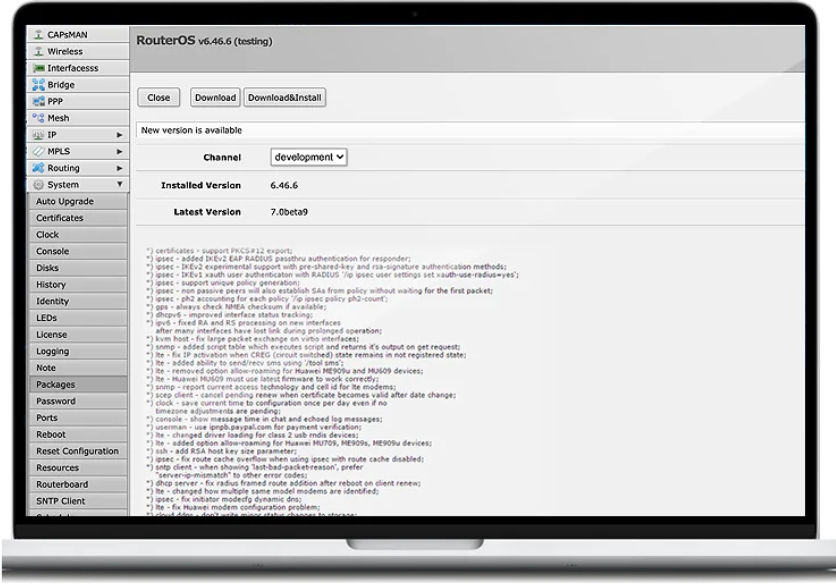
MikroTik RouterOS uses a continuous release system with different update channels. The latest stable version listed on the official changelog page as of November 22, 2026, is RouterOS 7.25.1, released on November 3, 2026. The latest long-term release is 7.24.6, released on November 2, 2026.
Downloads+2
RouterOS v7 includes ongoing improvements to routing, networking, wireless connectivity, security, and system stability.
Recent 7.25.1 maintenance updates include:
Improvements to bridge and MLAG behavior.
Fixes for DHCPv4 client packet handling.
Improvements to IPsec tunnel stability.
Fixes for HTTP Fetch behavior.
Corrections to SSH client parameters.
Improvements to IPv6 address lifetime handling.
Fixes affecting The Dude monitoring functions.
MikroTik community forum
RouterOS Release Channels
MikroTik provides different release channels for users with different stability requirements.
Channel | Purpose |
|---|---|
Long-term | Conservative updates focused on important fixes |
Stable | Recommended for most production users |
Testing | Pre-release testing and evaluation |
Development | Early development builds for experimentation |
For production routers, choose a suitable stable or long-term release rather than installing development builds without testing.
MikroTik RouterOS Free Download – Free vs. Paid Licensing
MikroTik RouterOS has several licensing arrangements. Whether you can use it for free depends on the hardware or installation type.
1. RouterOS on MikroTik Hardware
RouterOS comes preinstalled on supported MikroTik RouterBOARD devices. The included license level depends on the product.
If you purchase a compatible MikroTik router, you generally do not need to purchase a separate RouterOS license for its included operating system.
Different hardware models have different capabilities, so check the product specifications before purchasing.
2. RouterOS x86 Edition
RouterOS can also be installed on compatible x86 computers. This allows users to turn suitable PC hardware into a router or network gateway.
However, an x86 installation requires an appropriate RouterOS license. It should not be confused with the free CHR license.
Before installing RouterOS on a regular computer, check hardware compatibility, architecture, and licensing requirements.
3. Cloud Hosted Router (CHR)
Install MikroTik CHR on VPS » SYS-OPS.ID
Cloud Hosted Router is a virtual RouterOS edition designed for virtual machines and cloud environments.
It is useful for networking laboratories, virtual routers, testing, and cloud-based infrastructure.
The official CHR licensing options include:
License | Upload speed limit per interface | Price |
|---|---|---|
Free | 1 Mbps | Free |
P1 | 1 Gbps | $45 |
P10 | 10 Gbps | $95 |
P-Unlimited | Unlimited | $250 |
The Free license allows CHR to run indefinitely with a 1 Mbps upload limit per interface. Other RouterOS features are available without this throughput restriction being applied to them. Paid licenses provide higher throughput limits.
RouterOS Manual+1
4. Official Download Options
MikroTik provides different download packages depending on the installation type and device architecture.
Available options include:
RouterOS packages for supported hardware architectures.
x86 installation packages.
Cloud Hosted Router virtual disk images.
Netinstall utility for installation and recovery.
WinBox for graphical router management.
Additional RouterOS packages.
Always select the package that matches your device architecture. Installing an incompatible package can cause upgrade or compatibility problems.
MikroTik RouterOS System Requirements
RouterOS does not have one universal hardware requirement because it runs on different types of networking devices.
Physical MikroTik Router Requirements
For a hardware-based installation, you need:
A compatible MikroTik RouterBOARD device.
Supported RouterOS firmware.
Sufficient device memory and storage.
Compatible Ethernet, wireless, or SFP interfaces.
Appropriate power and network connections.
The available networking features depend on the specific router model.
x86 Installation Requirements
For a computer-based installation, consider the following:
Compatible x86 hardware.
Supported network interfaces.
Sufficient RAM and storage for the intended configuration.
A bootable USB drive or compatible installation media.
An appropriate RouterOS license.
The processing power required depends on traffic volume, routing complexity, VPN usage, firewall rules, and other enabled services.
CHR Virtualization Requirements
For a virtual installation, you need:
A supported virtualization platform.
Virtual CPU resources.
Allocated RAM.
Virtual disk storage.
One or more virtual network interfaces.
A suitable CHR license.
CHR can be deployed in environments such as VMware, Hyper-V, VirtualBox, and KVM, subject to the platform's compatibility and configuration requirements.
How to Download and Install MikroTik RouterOS
Follow these steps to obtain RouterOS from the official source.
Visit the official MikroTik download page.
Identify your router model or installation type.
Check the device architecture in the RouterOS administration interface under System and Resources.
Select the appropriate architecture and release channel.
Download the matching RouterOS package or CHR image.
Follow the installation or upgrade instructions for your device.
Connect to the router through WinBox, WebFig, or CLI.
Configure the required network settings.
Apply the appropriate license if your installation requires one.
For virtual installations, select the CHR section of the download page and download the image suitable for your hypervisor.
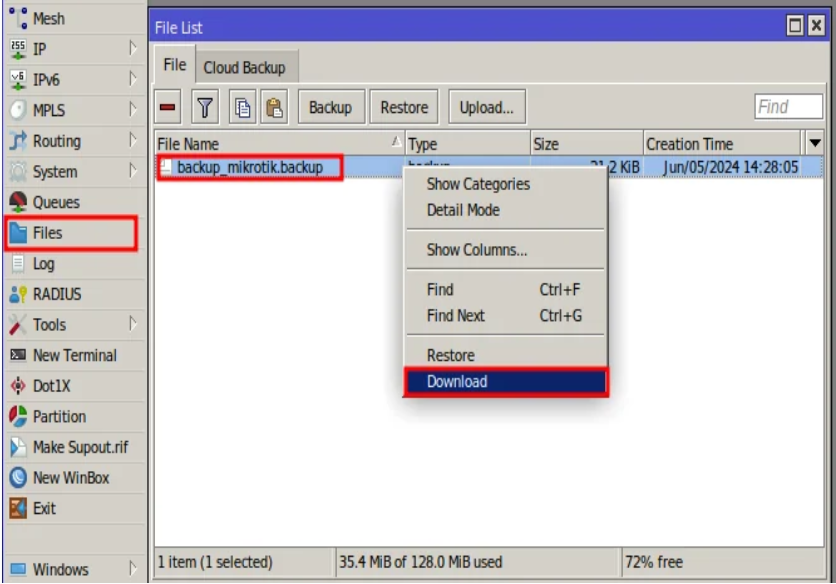
Important: Before upgrading an existing router, export its configuration and create a backup. Keep a copy somewhere other than the router itself. Make sure the device has sufficient storage and stable power during the upgrade process.
Downloads+1
How to Use MikroTik RouterOS
Once RouterOS is installed, you can configure your network through WinBox, WebFig, or the command line.
Step 1: Connect to Your MikroTik Router
Open WinBox on your computer and connect to the router. You can use an available IP address or the router's MAC address when supported.
Enter the appropriate login credentials to access the management interface.
Step 2: Configure WAN and LAN Interfaces
Identify the interfaces connected to your internet connection and internal network.
Configure the WAN interface according to your internet provider's requirements. Set up the LAN interface for your local devices.
Step 3: Assign IP Addresses
Open the IP address configuration section and assign an appropriate address to the LAN interface.
Make sure the selected address range does not conflict with another network.
Step 4: Configure DHCP
Set up a DHCP server if you want RouterOS to assign IP addresses automatically to connected computers, phones, and other devices.
Configure the address pool, gateway, and DNS information.
Step 5: Configure DNS
Enable and configure DNS services according to your network requirements.
You can use suitable upstream DNS servers and configure static entries when necessary.
Step 6: Create Firewall and NAT Rules
Configure firewall rules to control network traffic. Add NAT masquerading or other appropriate translation rules if your network needs internet access through a shared public IP address.
Test the configuration carefully to avoid accidentally exposing internal services.
Step 7: Configure Wireless Networking
If your device supports wireless networking, configure the network name, security settings, and access policies.
Use a strong password and appropriate wireless security settings.
Step 8: Manage Bandwidth
Create Simple Queues or Queue Trees to manage upload and download speeds.
You can configure limits for individual devices, customer accounts, or network segments.
Step 9: Set Up VPN Access
Choose a supported VPN protocol, such as WireGuard or IPsec, and configure the required authentication and firewall rules.
Test the connection from an authorized remote device.
Step 10: Monitor Network Performance
Use RouterOS monitoring and diagnostic tools to review interface traffic, system resources, logs, and connectivity.
Regular monitoring can help identify performance problems before they affect users.
MikroTik RouterOS for Different Users
1. Internet Service Providers
RouterOS offers tools that help ISPs manage customer connections, routing, and bandwidth allocation.
Common applications include:
PPPoE server management.
BGP routing.
OSPF configuration.
Customer bandwidth control.
Hotspot authentication.
Network traffic monitoring.
2. Small and Medium Businesses
Businesses can use RouterOS to manage office networks, internet access, and secure connections between different locations.
Its features support firewall configuration, VLAN segmentation, VPN connectivity, and network access management.
3. Home Network Administrators
Advanced home users can use RouterOS to create customized networks with separate wireless networks, firewall policies, VPN connections, and bandwidth controls.
It is particularly useful for users who want more control than a basic consumer router provides.
4. Network Engineers and Students
RouterOS is also useful for learning networking concepts and testing configurations.
Students and engineers can practice routing protocols, firewall rules, VPNs, VLANs, and network troubleshooting. CHR provides a convenient way to create virtual networking laboratories.
Benefits of Using MikroTik RouterOS
MikroTik RouterOS offers several advantages for managing modern networks.
Advanced routing: Supports static and dynamic routing protocols.
Network security: Provides firewall filtering, NAT, and access control.
Bandwidth management: Helps distribute internet speed between users.
VPN connectivity: Supports several remote-access and site-to-site VPN technologies.
Wireless management: Provides wireless configuration tools on supported hardware.
Virtualization: CHR allows RouterOS to run as a virtual machine.
Flexible administration: Supports WinBox, WebFig, CLI, and API management.
Network monitoring: Includes diagnostics, logging, and traffic monitoring.
Multiple deployment options: Can run on MikroTik hardware, compatible x86 systems, and virtual environments.
MikroTik RouterOS Pros and Cons
Pros
Extensive routing capabilities.
Advanced firewall and NAT configuration.
Powerful bandwidth-management tools.
Multiple VPN technologies.
Support for VLAN and network segmentation.
WinBox and WebFig graphical interfaces.
CHR virtualization support.
Useful network monitoring tools.
Suitable for ISP and business environments.
Free CHR license available for evaluation and limited-throughput use.
Cons
Advanced configuration can be difficult for beginners.
Requires networking knowledge for complex deployments.
Licensing depends on the installation type.
Hardware capabilities vary between MikroTik models.
Incorrect firewall settings can cause security problems.
Some advanced configurations require command-line experience.
MikroTik RouterOS vs. Alternative Networking Platforms
Several networking platforms provide routing, firewall, and network-management features. The best choice depends on your hardware, technical experience, and deployment requirements.
Software | Main strength |
|---|---|
MikroTik RouterOS | Integrated routing, firewall, wireless, and bandwidth management |
OpenWrt | Open-source router firmware and customization |
pfSense | Firewall, VPN, and network gateway management |
OPNsense | Open-source firewall and security management |
Ubiquiti UniFi | Centralized management of compatible networking hardware |
VyOS | Advanced software-based routing and network automation |
Cisco IOS | Enterprise networking and routing infrastructure |
RouterOS is particularly useful when you want a broad set of networking tools within one operating system. OpenWrt is attractive for compatible consumer routers, while pfSense and OPNsense are popular choices for dedicated firewall and gateway systems.
Frequently Asked Questions
1. Is MikroTik RouterOS free to download?
MikroTik provides official downloads, but licensing depends on the installation type. RouterOS comes with supported MikroTik hardware, while x86 installations require a license. CHR offers a free license with a 1 Mbps upload limit per interface.
2. What is the latest version of MikroTik RouterOS?
As of November 22, 2026, RouterOS 7.25.1 is the latest stable release listed by MikroTik. Version 7.24.6 is listed as the latest long-term release.
3. Can I install RouterOS on a regular PC?
Yes. RouterOS offers an x86 installation option for compatible computers. You must check hardware compatibility and obtain the appropriate license.
4. What is the difference between RouterOS and CHR?
RouterOS is the networking operating system used by MikroTik devices and compatible installations. CHR is its virtual-machine edition, designed for hypervisors and cloud environments.
5. Does MikroTik RouterOS support Windows?
RouterOS itself is not a Windows desktop application. It runs on supported MikroTik hardware, compatible x86 systems, and virtual machines. You can manage it from Windows using tools such as WinBox.
6. Can I use RouterOS without a license?
Supported MikroTik hardware includes its applicable RouterOS license. CHR also provides an indefinite free license with a 1 Mbps upload limit per interface. Other installations, such as x86, have separate licensing requirements.
7. What is the CHR free license speed limit?
The free CHR license has a 1 Mbps upload limit per interface. Other RouterOS features are available without additional restrictions under this free license.
8. Does RouterOS support WireGuard VPN?
Yes. RouterOS includes WireGuard support, allowing administrators to configure secure VPN connections between compatible devices.
9. Can I manage RouterOS using WinBox?
Yes. WinBox is a graphical management utility designed for configuring and monitoring MikroTik routers.
10. What is MikroTik Netinstall?
Netinstall is a MikroTik utility used to install or reinstall RouterOS on compatible devices. It is particularly useful for recovering devices or performing a clean installation.
11. Does RouterOS support BGP and OSPF?
Yes. RouterOS supports BGP and OSPF, along with other routing technologies used to manage networks of different sizes.
12. Where can I download MikroTik RouterOS safely?
Download RouterOS directly from the official MikroTik website:
Final Verdict
MikroTik RouterOS is a comprehensive networking operating system that provides advanced routing, firewall management, VPN connectivity, wireless configuration, bandwidth control, and network monitoring. Its flexibility makes it suitable for home network enthusiasts, businesses, internet service providers, and professional network engineers.
One of its biggest advantages is its variety of deployment options. You can use it on supported MikroTik hardware, compatible x86 computers, or virtual machines through Cloud Hosted Router. The free CHR license also provides an opportunity to explore RouterOS without purchasing a license, although its 1 Mbps upload limit per interface makes it unsuitable for many production workloads.
If you want powerful networking tools and greater control over your infrastructure, MikroTik RouterOS is worth exploring. Choose the correct architecture and release channel, check the licensing requirements, and download the official package from MikroTik.