Takehouse AI Music Creator Free Download – Features, AI Song Generation, System Requirements & Installation Guide
Introduction to Takehouse AI Music Creator
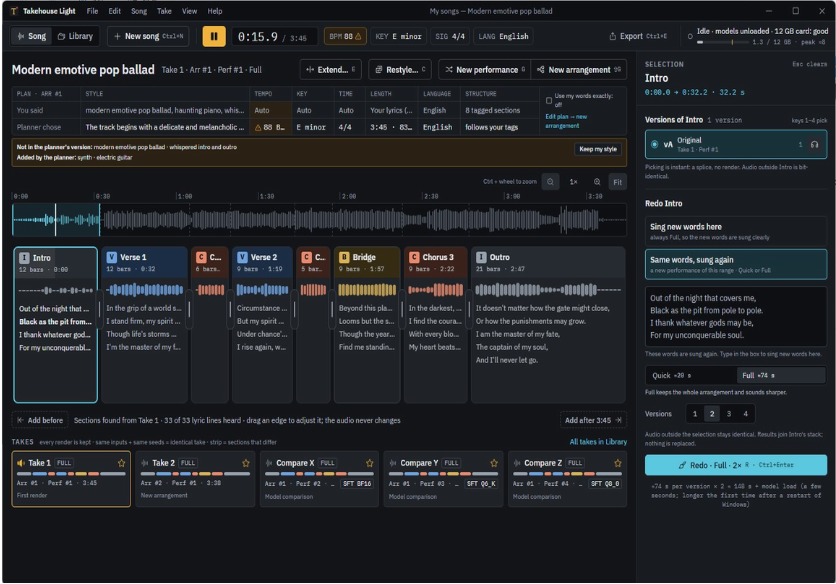
Takehouse AI Music Creator is a Windows-based AI music production application designed to generate complete songs with instrumental arrangements and vocals. It offers a different approach to AI music creation by allowing users to create a song and continue editing individual sections instead of generating an entirely new track whenever something needs to change.
The software is designed for musicians, songwriters, music enthusiasts, content creators, and anyone interested in experimenting with AI-generated music. Users can describe a song, provide their own lyrics, review a proposed song structure, and generate music using AI models that run locally on a compatible NVIDIA graphics card.
One of its interesting features is its section-based editing workflow. You can regenerate a verse, change the lyrics of a chorus, extend an existing composition, or experiment with another musical style while preserving the sections you want to keep.
If you are searching for Takehouse AI Music Creator free download, it is important to verify the application's source and licensing information first. Version 1.0.0 is listed on third-party software websites, but a developer-owned official download page and definitive licensing terms could not be independently verified. This guide explains the reported features and installation considerations without treating unofficial downloads as verified official releases.
What Is Takehouse AI Music Creator?
Takehouse AI Music Creator is described as an AI-powered music workstation that runs on a Windows PC. Rather than relying entirely on cloud-based music generation, it uses local AI models to plan, compose, and generate musical arrangements and vocals through supported NVIDIA graphics hardware.
The application is designed around editable song projects. Each generated version, known as a take, can be saved with its project information and generation settings. This allows users to revisit previous versions and reproduce results using the saved generation data.
The software also offers Quick and Full generation modes. Quick mode is intended for creating faster drafts, while Full mode is designed for higher-quality final output.
Another useful feature is its ability to modify individual sections. If you like the instrumental arrangement but want a different chorus, you can work on that section without rebuilding the entire song.
Key Features of Takehouse AI Music Creator
1. AI-Powered Song Generation
Takehouse AI Music Creator is designed to generate songs from written descriptions and user-provided lyrics.
Users can describe the type of music they want, including the general mood, genre, style, and musical direction. The application's planning system uses this information to prepare a song structure before generating the musical content.
This approach can help users turn a basic musical idea into a more complete composition.
It is useful for:
Creating original song drafts
Experimenting with different music styles
Producing background music ideas
Exploring AI-generated vocal arrangements
Developing musical concepts for creative projects
2. AI-Generated Vocals
One of the main features of Takehouse is its ability to generate songs with vocals.
Users can provide lyrics and allow the AI models to perform them as part of the generated composition. This makes the application useful for people who want to experiment with complete songs rather than instrumental-only tracks.
The vocal generation process is integrated into the music workflow, allowing users to revise selected sections and generate alternative vocal performances.
The final vocal quality can vary depending on the musical style, lyrics, and generation settings.
3. Custom Lyrics
Takehouse allows users to write their own lyrics instead of relying entirely on automatic text generation.
You can enter original verses, choruses, and other song sections. The application uses these lyrics as part of its music-generation workflow.
This is particularly useful for songwriters who already have ideas but need help developing an instrumental arrangement and vocal performance.
Users can also revise selected lyrics and regenerate the corresponding section.
4. AI-Assisted Lyrics Writing
The application includes an optional lyric-writing workflow that can use an online AI service.
Users can configure an external AI service with their own API key to help generate or refine lyrics. Certain services may offer free API access subject to their individual terms and usage limits.
An optional local lyric-writing tool is also described in third-party product information.
It is important to distinguish lyric writing from music generation: the core music and vocal generation is described as local, while the optional online lyric-writing service may send text prompts to an external provider.
5. Section-Based Song Editing
Takehouse is designed to let users edit a specific part of an existing composition.
For example, you might like the first verse and chorus but want to change the second verse. Instead of generating a completely different song, you can select the section that needs improvement and create another version.
Reported section-editing options include:
Rewrite a selected section with new lyrics
Regenerate a vocal performance using existing words
Create alternative versions of a verse
Generate a different chorus
Compare saved versions
Preserve unchanged sections
This workflow is useful for users who want more control over the final song.
6. Quick and Full Generation Modes
The application offers two generation modes designed for different stages of music production.
Quick Mode
Quick mode is intended for generating faster song drafts. It allows users to explore musical ideas and evaluate a composition before committing to a more detailed generation.
It can be useful when testing different styles, lyrics, or arrangements.
Full Mode
Full mode is designed to produce the higher-quality version of a song. It is intended for users who have reviewed their initial ideas and are ready to create a more complete result.
Both modes are described as running locally on the computer.
7. Song Extension
Sometimes an AI-generated song may feel too short or need an additional musical section.
Takehouse includes a song-extension workflow that can add material before or after an existing composition. Users can provide new lyrics for the additional section where supported.
This feature is useful for:
Adding another verse
Extending an ending
Creating a longer composition
Developing a musical introduction
Experimenting with additional song sections
The original portions of the composition are intended to remain unchanged during the extension process.
8. Change the Style of an Existing Song
Takehouse allows users to experiment with alternative musical styles.
You can use the style-modification workflow to create a different interpretation of a composition or imported recording.
For example, you might want to explore how a musical idea sounds in a different genre or arrangement.
This feature can be useful for generating multiple creative directions from one initial concept.
9. Song Planning and Structure Preview
Before generating a song, Takehouse can display a proposed musical plan.
Reported planning information includes:
Tempo
Musical key
Time signature
Song sections
Musical style description
Elements added or removed during planning
Users can review the proposed structure and make changes before starting the generation process.
This gives users more control over the musical direction and helps them understand how the application intends to organize the composition.
10. Reproducible Music Takes
Takehouse saves generated versions as individual takes.
Each take is associated with its project information and generation settings, including the seeds used during generation. This allows users to reproduce a previous result using the same saved inputs and configuration.
The feature is particularly useful when experimenting with several versions of the same song.
Instead of losing an earlier result after creating a new one, you can keep multiple versions and compare them later.
11. Compare and Combine Section Versions
The section-based workflow allows users to generate several alternatives for an individual part of a song.
For example, you can create multiple chorus performances and choose the one that sounds best.
The application can keep these versions organized under their corresponding sections. Users can select preferred versions and combine them into a new take without necessarily regenerating the entire composition.
This is helpful for refining a song gradually.
12. WAV and MP3 Audio Export
Takehouse supports exporting completed songs in common audio formats.
Reported export options include:
WAV audio export
MP3 audio export
WAV 16-bit output
WAV 24-bit output
WAV 32-bit floating-point output
Volume normalization options
These options provide flexibility for listening, sharing, and further editing.
The project archive option can also help preserve project information for future work.
13. Local AI Music Generation
One of the most distinctive aspects of Takehouse is its local processing approach.
The music-planning, instrumental-generation, and vocal-generation models are described as running on the user's NVIDIA graphics card.
This means the core music-generation workflow is not designed around uploading every musical project to a remote generation service.
Local processing may be attractive to users who prefer keeping their creative work on their own computers.
However, optional online lyric-generation tools can involve external services, so users should review the privacy policies and API settings of any connected provider.
14. Backup and Restore
Takehouse includes backup and restore options for preserving project-related information and application settings.
Users can create backups on another storage drive and restore them later.
This is useful when moving to another computer, reinstalling Windows, or protecting important music projects.
If external API keys are included in a backup, users should protect the backup with a strong password and store it securely.
How Takehouse AI Music Creator Works
The application follows a project-based music-generation process.
Step 1: Describe Your Song
Start by entering a description of the song you want to create.
You can describe the general genre, mood, arrangement, and musical direction.
Step 2: Add Your Lyrics
Write your own lyrics or use an available lyric-writing option.
Organize your text into the appropriate song sections, such as verses and choruses.
Step 3: Review the Song Plan
The application prepares a proposed structure and displays available musical information, such as tempo, key, and time signature.
Review the plan before generating the song.
Step 4: Select a Generation Mode
Choose Quick mode for an initial draft or Full mode for a higher-quality generation.
The appropriate choice depends on your workflow and available hardware.
Step 5: Generate the Music
Start the generation process and allow the AI models to create the musical arrangement and vocals.
Processing time depends on your computer's graphics hardware and the selected generation mode.
Step 6: Review the Generated Take
Listen to the result and identify the sections you want to improve.
Keep the versions you like so you can compare them later.
Step 7: Edit Individual Sections
Select a verse, chorus, or other available section and generate an alternative version.
You can revise the lyrics or request a different performance while preserving the remaining parts.
Step 8: Extend or Restyle the Song
If necessary, extend the composition or experiment with a different musical style.
Compare the alternatives before selecting your preferred result.
Step 9: Export the Finished Track
When the composition is ready, export it in WAV or MP3 format.
Keep a project archive or backup if you plan to continue editing the song later.
Benefits of Using Takehouse AI Music Creator
Takehouse offers several interesting features for people exploring AI-powered music production.
Create Complete Songs
The software is designed to generate music with vocals rather than focusing only on instrumental backgrounds.
Keep Your Music Projects Local
Its core music-generation workflow is described as running on a compatible local NVIDIA GPU.
Edit Individual Sections
You can revise a verse or chorus without rebuilding the entire song.
Experiment with Musical Styles
The style-modification feature provides additional creative possibilities for existing compositions.
Preserve Previous Versions
Saved takes make it easier to compare different performances and return to earlier ideas.
Generate Faster Drafts
Quick mode helps users experiment with musical ideas before creating a more detailed version.
Export in Common Formats
WAV and MP3 export options make it easier to use generated music in other creative applications.
Manage Creative Projects
Project archives and backup options help preserve important work and generation settings.
Takehouse AI Music Creator System Requirements
Takehouse is a demanding application because its core music and vocal generation models run locally.
A compatible NVIDIA graphics card is an important requirement. Before downloading or installing the software, check your computer's hardware.
The following specifications are reported in third-party version 1.0.0 listings and should be treated as indicative rather than independently verified official requirements.
Minimum Windows Requirements
Operating system: Windows 10 version 19045 or later
Architecture: 64-bit (x64)
Processor: Quad-core Intel Core i5 or AMD Ryzen 5-class CPU
RAM: 8 GB
Graphics card: NVIDIA GeForce RTX 20 Series or newer
GPU memory: 8 GB VRAM
NVIDIA driver: Version 536.40 or later
Installation storage: Approximately 11.1 GB
The generation process may require around 7.5 GB of available GPU memory while creating a song.
Recommended Configuration
For a smoother experience, consider a more powerful computer with:
Windows 10 22H2 or Windows 11 64-bit
Compatible NVIDIA GeForce RTX graphics card
12 GB VRAM or more
16 GB RAM or more
Approximately 12.2 GB of available storage
The exact amount of storage and memory needed can vary depending on the installed version, model files, and project data.
Important GPU Considerations
Takehouse is described as relying on NVIDIA RTX graphics hardware for local music generation.
A computer with only integrated graphics or an unsupported GPU may not be suitable for the application's main workflow.
Before installation, check:
Whether your graphics card belongs to a supported RTX generation
Whether sufficient VRAM is available
Whether the NVIDIA driver is compatible
Whether enough GPU memory remains available during generation
Whether your computer has enough free disk space
If you are using an older laptop or desktop, check the graphics hardware carefully before downloading a large installer.
Takehouse AI Music Creator Free Download Options
Users searching for Takehouse AI Music Creator free download should understand that the available product information does not establish a verified official licensing model.
Third-party descriptions identify version 1.0.0 and advertise local music generation, but they do not provide sufficiently reliable evidence of the developer's official pricing, free edition, trial restrictions, or commercial licensing conditions.
Is Takehouse AI Music Creator Free?
The application's definitive free-versus-paid status could not be independently confirmed from a developer-owned source.
Do not assume that a third-party download listing proves the software is permanently free. Check the license agreement and publisher information included with a legitimate installer before using the application.
Does It Require a Subscription?
Some third-party descriptions state that Takehouse operates without an account or subscription. However, this information has not been confirmed through an independently verified developer website.
Review the application's licensing information before relying on this claim.
Does It Require an Internet Connection?
The core music and vocal generation process is described as local. However, an optional online AI lyric-writing service may require an internet connection and an API key.
Downloading optional components, updates, or other external services may also require internet access.
Why Use a Trusted Installer?
Downloading unknown software from unofficial websites can expose your computer to modified installers, malware, unwanted applications, or unauthorized activation tools.
Before running an installer, verify its publisher, digital signature, file integrity, and license information where available.
Avoid cracked or repackaged versions, especially when an application requires access to your graphics hardware and local files.
How to Download and Install Takehouse AI Music Creator
Because a developer-owned official download page could not be verified, the following is a general installation workflow rather than a confirmed official download procedure.
Step 1: Verify the Software Publisher
Identify the developer or publisher responsible for Takehouse AI Music Creator.
Look for a developer-owned website, product documentation, and a legitimate download source.
Step 2: Check the Version
Confirm that the installer is for Takehouse AI Music Creator 1.0.0 or another version documented by the publisher.
Avoid installers that have unclear version information or misleading download buttons.
Step 3: Check Your Hardware
Verify your Windows version, processor, RAM, NVIDIA graphics card, VRAM, and available storage.
The application is described as requiring a compatible RTX graphics card.
Step 4: Verify the Installer
Before opening the downloaded file, check its digital signature and scan it with reputable security software.
Do not disable Windows security features to force an unknown installer to run.
Step 5: Run the Installer
If the installer is verified and its publisher is trusted, open it and follow the displayed setup instructions.
Review any license agreement and installation options carefully.
Step 6: Complete Installation
Allow the setup process to install the required application files and AI components.
The installation may require substantial disk space.
Step 7: Launch the Application
Open Takehouse AI Music Creator from the Windows Start menu or desktop shortcut if one is created.
Review the application settings and check whether the graphics card is detected correctly.
Step 8: Configure Optional Lyrics Tools
If you want to use an external AI lyric-writing service, review its API requirements and privacy terms before entering an API key.
Do not share API keys publicly or include them in unprotected backups.
Step 9: Create a Test Project
Start with a short musical idea and test the generation workflow before creating a larger project.
This helps confirm that your hardware and application installation are working correctly.
How to Create Your First Song
Once the application is installed and configured, you can begin experimenting with AI music generation.
1. Start a New Project
Open Takehouse and create a new music project.
Choose a descriptive project name so you can identify the composition later.
2. Enter a Musical Description
Write a description of the sound you want.
For example, you could describe an upbeat electronic track, a relaxed acoustic arrangement, or a dramatic cinematic composition.
Be clear about the mood, musical direction, and desired vocal style.
3. Add Your Lyrics
Enter your own lyrics and organize them into verses, choruses, and other song sections.
If you use an AI lyric-writing option, review the generated text before including it in your project.
4. Review the Song Structure
Check the proposed tempo, key, time signature, and song sections.
Make changes if the proposed plan does not match your creative idea.
5. Generate a Quick Draft
Use Quick mode to create an initial version of your composition.
Listen carefully to the vocals, instrumental arrangement, and overall structure.
6. Create a Full Version
After reviewing the draft, use Full mode to generate the intended higher-quality result.
The processing time will depend on your GPU and the complexity of the generation.
7. Improve Selected Sections
If a particular verse or chorus does not sound right, regenerate that section.
Try alternative lyrics or another vocal performance while preserving the sections you want to keep.
8. Compare Your Takes
Listen to the available versions and select the strongest performance for each section.
Save your preferred combination as a new take.
9. Export the Song
Choose WAV or MP3 output and select the available audio settings.
Save the finished composition and keep a backup of the project if you want to edit it again.
Pros and Cons of Takehouse AI Music Creator
Pros
AI-powered song and vocal generation.
Local music generation on compatible NVIDIA hardware.
Song creation from written descriptions.
Support for user-written lyrics.
Section-by-section regeneration.
Quick and Full generation modes.
Song extension and style modification.
Saved takes and reproducible generation settings.
WAV and MP3 export.
Project backup and restore options.
Cons
Windows-only application according to available version information.
Requires a compatible NVIDIA RTX graphics card.
High GPU memory requirements.
Large installation size.
Definitive official licensing and pricing information is unclear.
Developer-owned download page could not be verified.
Optional AI lyric writing may require an online service.
Generated music and vocals may need additional refinement.
Best Alternatives to Takehouse AI Music Creator
If Takehouse does not match your hardware or creative workflow, consider these AI music-generation alternatives.
Suno AI
Suno is an online AI music-generation service that allows users to create songs from written prompts and lyrics. It is suitable for people who want to experiment with music without setting up a local AI workstation.
Udio
Udio is an AI music-generation platform designed for creating musical ideas and exploring different song styles. Its online workflow can be useful for users who prefer a browser-based service.
AIVA
AIVA focuses on AI-assisted music composition, including instrumental and soundtrack-oriented projects. It can be useful for composers and content creators looking for structured musical ideas.
Soundraw
Soundraw is an AI music-generation service designed for creating customizable background music. It is particularly relevant for video creators and other users who need music for content projects.
MusicGen
MusicGen is an open-source AI music-generation model from Meta. It is an option for technically experienced users interested in experimenting with local or research-oriented music-generation workflows.
ACE-Step
ACE-Step is an AI music-generation project that provides another option for users interested in locally managed music-generation models and more technical workflows. Hardware and setup requirements depend on the implementation.
Frequently Asked Questions
Is Takehouse AI Music Creator free to download?
Takehouse AI Music Creator 1.0.0 appears on third-party software listings, but its official pricing and licensing terms could not be independently confirmed. Check the publisher's documentation before assuming it is free.
What is the latest version of Takehouse AI Music Creator?
The version identified in the available third-party listings is 1.0.0. A verified official release history was not available.
Does Takehouse AI Music Creator work offline?
Its core music and vocal generation models are described as running locally on a compatible NVIDIA GPU. Optional online lyric-writing services and other internet-dependent functions may still require connectivity.
Can Takehouse generate songs with vocals?
Yes. Available product descriptions identify instrumental and vocal generation as core capabilities.
Can I use my own lyrics?
Yes. The described workflow allows users to enter their own lyrics and use them as part of song generation.
Which graphics card does Takehouse require?
Third-party requirements list an NVIDIA GeForce RTX 20 Series or newer GPU with at least 8 GB of VRAM. Around 12 GB VRAM is recommended in some listings.
Does Takehouse AI Music Creator support Windows 11?
The available requirements describe compatibility with Windows 10 and Windows 11 64-bit systems. Verify the exact supported Windows version before installation.
Can I regenerate only one part of a song?
Yes. Section-based editing is one of the application's main advertised features. Users can create alternative versions of selected sections while preserving other parts.
Which audio formats are supported?
Available descriptions list WAV and MP3 export. WAV output is reported to include 16-bit, 24-bit, and 32-bit floating-point options.
Can I extend an existing song?
Yes. The described extension workflow allows users to add material before or after an existing composition.
Does Takehouse require an online account?
Some third-party listings claim that the core application does not require an account. However, this has not been confirmed through a verified developer-owned source.
Can generated songs be used commercially?
Commercial-use rights could not be independently verified. Review the software's actual license agreement and the terms of any AI models or external services before publishing, selling, or monetizing generated music.
Does Takehouse upload my music to the cloud?
Available descriptions state that the core music generation runs locally and that music does not leave the computer during this process. Optional online lyric-writing tools may send text to an external AI provider.
Is Takehouse suitable for beginners?
The text-prompt and section-based workflow may be accessible to beginners interested in experimenting with AI music. However, the hardware requirements and song-editing controls may take time to understand.
Conclusion
Takehouse AI Music Creator is an interesting AI music workstation designed for users who want to generate complete songs with vocals and continue refining them section by section. Its reported features include local AI music generation, custom lyrics, Quick and Full modes, song extension, style modification, reproducible takes, and WAV and MP3 export.
Its local-processing approach may appeal to users who prefer generating music on their own computers rather than relying entirely on cloud services. However, the software requires compatible NVIDIA RTX graphics hardware and substantial storage space.
Before searching for Takehouse AI Music Creator free download, verify the publisher, installer, version, and licensing terms. The available information identifies version 1.0.0 but does not establish a verified official download page or definitive free-use policy.
If you have compatible hardware and can verify a legitimate installer, the application's section-based workflow offers an interesting way to experiment with AI-generated songs, revise individual performances, and develop original musical ideas.