WindowManager by DeskSoft is a Windows utility designed to make desktop organization easier. It remembers the positions and sizes of application windows and can restore them automatically when you reopen programs. Instead of repeatedly resizing and arranging the same windows, you can let WindowManager maintain your preferred desktop layout.
The software is particularly useful for people who work with several applications, use multiple monitors, or regularly switch between different desktop tasks. It also provides customizable rules and automation options for controlling how individual windows behave.
If you are searching for a WindowManager free download, you can try the software before purchasing a license. However, it is commercial software rather than a permanently free application. This guide explains its features, trial, system requirements, installation process, and alternatives.
What Is WindowManager?
WindowManager is a desktop enhancement utility developed by DeskSoft. Its main purpose is to remember where application windows are located and how large they are. When you open those applications again, the software can automatically restore their previous positions and dimensions.
For example, if you normally keep your browser on the left side of the screen and your file manager on the right, WindowManager can help maintain that arrangement. It also works with Windows Explorer, application windows, and dialog boxes.
Unlike basic window-snapping tools, WindowManager provides customizable rules that let you decide how individual applications should behave. You can lock window positions, create different profiles, and configure actions that run when a window opens.
Key Features of WindowManager
1. Automatic Window Position Restoration
One of the most useful features is automatic window-position restoration. WindowManager remembers the location and dimensions of supported application windows between sessions.
When an application opens again, the utility can return it to your preferred location. This is particularly helpful when you regularly work with the same group of programs.
2. Customizable Window Rules
WindowManager allows you to create individual rules for different applications and windows. You can configure how a window should behave when it appears on your desktop.
Available rule options include:
Moving windows to specific screen locations.
Changing window dimensions.
Activating selected windows.
Closing windows automatically.
Applying different settings to particular applications.
These rules help you create a desktop environment that matches your daily workflow.
3. Lock Window Position and Size
Some applications frequently change their window dimensions or reopen in inconvenient locations. WindowManager can lock selected windows so they retain their preferred positions and sizes.
This is useful for keeping reference documents, communication applications, monitoring tools, and other frequently used programs in consistent locations.
4. Multiple Profiles
Different activities often require different desktop arrangements. WindowManager supports multiple profiles, allowing you to maintain separate configurations.
For example, you might create profiles for:
Office and productivity work.
Programming and development.
Research and browsing.
Entertainment and personal tasks.
Its trigger system can help switch profiles according to configured conditions.
5. Multi-Monitor Support
WindowManager supports multi-monitor configurations, making it useful for people who work with extended desktop setups.
You can configure applications to appear on preferred displays and maintain their window arrangements. This reduces the time spent moving programs between monitors whenever you restart your computer or reopen an application.
6. Advanced Automation
The application offers automation options that go beyond basic window positioning. When a selected window opens, WindowManager can perform configured actions such as:
Sending keyboard shortcuts.
Typing predefined text.
Performing mouse clicks.
Launching additional programs.
Executing other supported window-related actions.
These capabilities are useful for repetitive workflows, although you should test automation rules carefully before relying on them.
7. Minimize Windows to the System Tray
WindowManager can minimize most supported windows to the Windows system tray area. This provides another way to reduce desktop clutter while keeping applications accessible.
It can be particularly helpful when several programs are running simultaneously and you want to keep the taskbar organized.
8. Windows Virtual Desktop Enhancements
WindowManager also supports and enhances virtual desktop functionality in Windows 10 and Windows 11.
Its features include additional hotkey options and individual desktop icon configurations. These capabilities can make switching between different workspaces more convenient.
9. Keyboard Shortcuts and Customization
Keyboard shortcuts provide faster access to supported commands and actions. You can configure the application to match your preferred working habits.
The customizable settings also help users create rules for frequently used applications instead of repeatedly adjusting windows manually.
10. Silent Installation and Deployment
WindowManager supports silent installation and uninstallation, which can be useful for administrators and organizations managing multiple Windows computers.
This functionality makes it easier to deploy the utility in managed environments without requiring every user to complete the standard installation process manually.
What's New in WindowManager?
The latest version reported by several software download listings in November 2026 is WindowManager 10.27.4. MajorGeeks lists this release with a date of November 11, 2026, while other listings report it around November 8–9.
MajorGeeks+2
Recent releases focus on maintenance, stability, and improvements to the existing window-management functionality. The exact change history should be checked on the developer's version-history page before upgrading.
For the latest installer, use the official DeskSoft download page.
WindowManager Free Download – Trial vs. Full Version
WindowManager is commercial software offered by DeskSoft. Users can download the installer and try the application before purchasing a license.
The unregistered edition is listed by software directories as a 30-day trial. After the trial period, you need a valid license to continue using the registered version.
MajorGeeks+1
The developer's purchase page currently lists the full license at USD $20.00. It also states that the license does not expire. Check the official website for the latest purchase and upgrade conditions.
Edition | Details |
|---|---|
Trial | Test the software before purchasing |
Full version | Licensed access to the commercial application |
License price | USD $20 listed by DeskSoft |
License duration | Permanent according to the purchase page |
If you only want to evaluate the features, start with the official trial installer. Avoid modified installers, unauthorized activation patches, and key generators because they can introduce security risks and licensing problems.
WindowManager System Requirements
WindowManager is designed for Microsoft Windows. The developer lists support for both 32-bit and 64-bit Windows installations.
Requirement | Supported platform |
|---|---|
Windows 11 | Supported |
Windows 10 | Supported |
Windows 8 | Supported |
Windows 7 | Supported |
Windows Vista | Supported |
Windows Server | Supported |
Windows XP | Up to version 6.6.2 only |
Architecture | 32-bit and 64-bit |
The developer particularly highlights Windows 10 and Windows 11 as its intended modern platforms. Windows XP users need an older release rather than the current version.
A specific modern CPU or RAM requirement is not listed on the official product page. A compatible Windows computer and sufficient storage for the small installer should be adequate for typical use.
How to Download and Install WindowManager
Follow these steps to download and install the application safely:
Open the official DeskSoft WindowManager website.
Navigate to the download section.
Select the current WindowManager installer.
Download the setup file named
WMSetup.exe.Open the downloaded installer.
Follow the installation wizard.
Launch WindowManager after installation.
Configure your preferred window positions, rules, and profiles.
Activate your purchased license if you decide to continue using the registered version.
The official download page also provides a SHA-256 checksum option for verifying the downloaded installer. This is useful for checking file integrity.
How to Use WindowManager
After installation, you can begin configuring your desktop layout.
Step 1: Launch the Application
Open WindowManager from the Windows Start menu. Explore the main interface to understand its configuration options.
Step 2: Configure Window Rules
Select an application or window for which you want to create a custom rule. Set the preferred position, dimensions, and other available behaviors.
Step 3: Set Window Positions
Arrange your application windows where you want them to appear. Configure WindowManager to remember or restore these positions when the programs reopen.
Step 4: Create Profiles
Create separate profiles for different activities. Configure the applications and window arrangements you want to use in each workspace.
Step 5: Configure Automation
If needed, create actions that send keyboard input, perform mouse clicks, or launch additional programs when selected windows open.
Step 6: Test Your Configuration
Close and reopen the selected applications to check whether the rules work as expected. Adjust individual settings if a window does not appear in the correct position.
Step 7: Save Your Preferred Setup
Keep your configured rules and profiles so you can maintain a consistent desktop arrangement during future sessions.
Benefits of Using WindowManager
WindowManager can improve everyday desktop productivity in several ways.
Less manual work: Automatically restores preferred window positions.
Better organization: Keeps frequently used applications in consistent locations.
Flexible workspaces: Supports multiple profiles for different activities.
Multi-monitor convenience: Helps maintain arrangements across multiple displays.
Custom automation: Performs selected actions when windows open.
Reduced desktop clutter: Can minimize supported applications to the system tray.
Personalized behavior: Allows users to configure individual window rules.
These advantages are most noticeable for people who regularly use several applications at the same time.
WindowManager vs. Other Window Management Tools
There are several alternatives for users who want more control over Windows desktop layouts.
Software | Main purpose |
|---|---|
WindowManager | Remembers and restores window positions and sizes |
Microsoft PowerToys FancyZones | Creates custom window-layout zones |
DisplayFusion | Provides advanced multi-monitor management |
AquaSnap | Offers window snapping, tiling, and resizing tools |
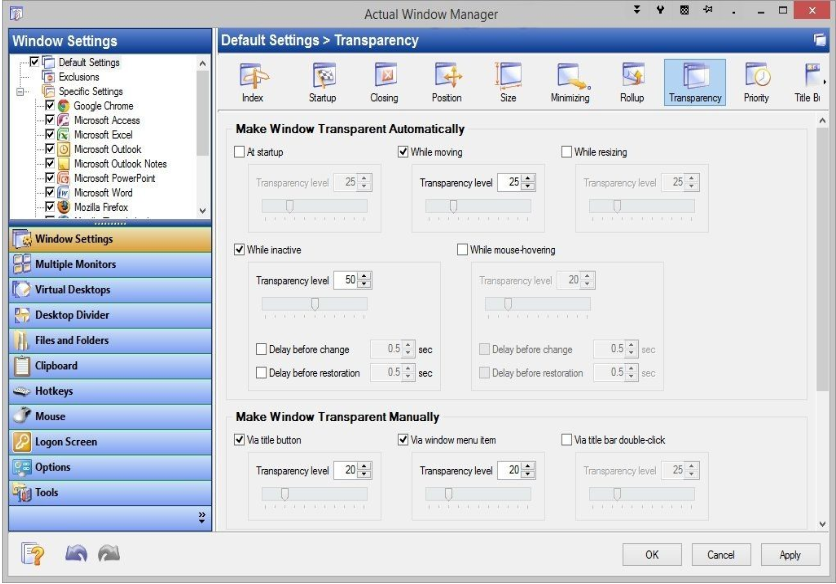
Actual Window Manager | Provides extensive desktop and window customization |
Windows Snap Layouts | Organizes windows using built-in Windows features |
WindowManager is a suitable choice when automatic window restoration and application-specific rules are your main priorities. PowerToys FancyZones is worth considering for custom layout zones, while DisplayFusion is a broader option for advanced multi-monitor management.
Pros and Cons of WindowManager
Pros
Automatically remembers window positions and dimensions.
Supports application-specific window rules.
Offers multiple desktop profiles.
Works with multi-monitor configurations.
Provides keyboard and mouse automation.
Can minimize supported applications to the system tray.
Supports Windows virtual desktop enhancements.
Offers silent installation and uninstallation.
Cons
It is commercial software after the trial period.
It is designed for Windows rather than macOS or Linux.
Advanced rules may require some configuration experience.
Automation settings need testing to avoid unwanted actions.
Some built-in Windows features may already be sufficient for casual users.
Frequently Asked Questions
1. Is WindowManager free to download?
You can download and try WindowManager without purchasing it first. However, it is commercial trialware, and the unregistered version is listed as having a 30-day trial.
2. What is the latest version of WindowManager?
WindowManager 10.27.4 is reported by software download listings as the latest release in November 2026. Check DeskSoft's official website for the current installer.
3. Does WindowManager work on Windows 11?
Yes. The developer specifically lists Windows 11 support.
4. Can WindowManager remember application positions?
Yes. Its main purpose is to remember and restore the positions and sizes of supported application windows between sessions.
5. Does WindowManager support multiple monitors?
Yes. It includes multi-monitor support and can help maintain preferred application arrangements across displays.
6. Can I create multiple window profiles?
Yes. WindowManager supports multiple profiles and a trigger system for profile switching.
7. Can WindowManager automatically type text?
Yes. Its advanced actions can send keyboard input, type predefined text, and perform mouse clicks when configured windows open.
8. Does WindowManager work on macOS?
No. DeskSoft lists it as a Windows application.
9. How much does WindowManager cost?
DeskSoft currently lists the full license for USD $20. Check its official purchase page for updated pricing and licensing conditions.
10. Where can I download WindowManager safely?
The safest source is the developer's official website: DeskSoft WindowManager Download.
Final Verdict
WindowManager is a useful desktop enhancement utility for Windows users who want more control over application window positions, sizes, and behavior. Its automatic restoration, customizable rules, multiple profiles, multi-monitor support, and automation options make it more flexible than basic window-arrangement features.
Although it is not permanently free, its trial gives users an opportunity to evaluate the software before purchasing. The full license is listed at USD $20, making it worth considering if you frequently organize several applications or maintain a specific desktop layout.
If you want a more organized Windows workspace with less repetitive manual adjustment, WindowManager is worth testing. Download the legitimate installer from DeskSoft and choose the license that fits your requirements.