AI Text To Image Generator Pro Free Download – Features, Guide, and Installation
Introduction
Artificial intelligence is changing how people create digital artwork, illustrations, and visual content. Instead of drawing every detail manually, users can describe an idea in words and let an AI-powered tool transform that description into an image. This approach can help designers, bloggers, marketers, students, and content creators explore creative ideas more efficiently.
AI Text To Image Generator Pro is a name associated with software intended for AI-assisted image creation. Tools in this category typically use text prompts to generate visuals based on a subject, setting, artistic style, and other descriptive details. Depending on the specific application, users may also have access to image customization, different visual styles, and export options.
If you are searching for AI Text To Image Generator Pro free download, it is important to identify the exact application before installing it. Products with similar names may have different developers, features, operating system requirements, and licensing terms.
In this guide, we explore how AI text-to-image software works, its potential features, common applications, installation considerations, and ways to find a legitimate download source.
What Is AI Text To Image Generator Pro?
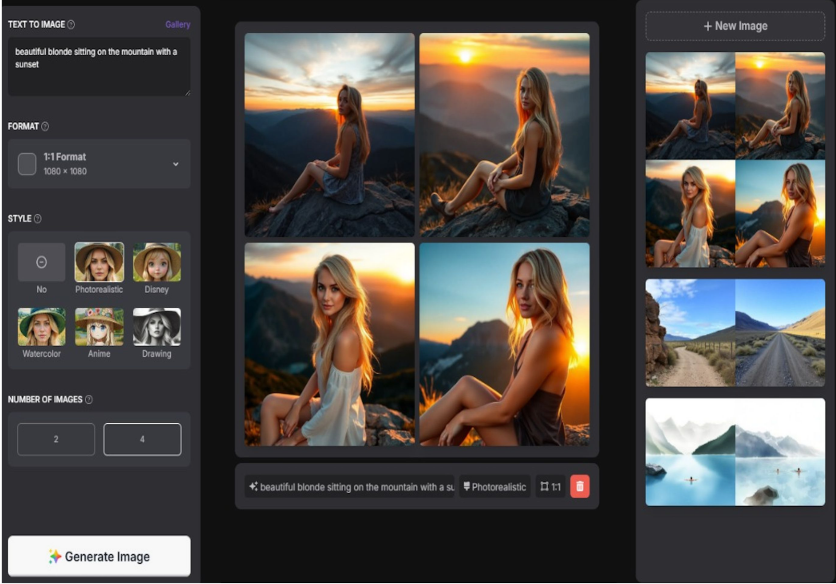
AI text-to-image software generates visual content from written descriptions. A user enters a prompt explaining what they want to see, and the underlying AI model attempts to produce an image that matches the description.
For example, a prompt might describe a futuristic city at sunset, a realistic landscape with mountains, or a colorful illustration of a fictional character. The generated result depends on the model, prompt, available settings, and capabilities of the application.
The word “Pro” often indicates a professional edition or a product marketed toward users who need additional features. However, the exact meaning depends on the particular software. It does not automatically mean that the application includes unlimited image generation, commercial usage rights, offline processing, or free access to premium functions.
Before downloading AI Text To Image Generator Pro, check the developer's identity and official product documentation. This helps ensure that the information you rely on corresponds to the correct application.
Key Features of AI Text To Image Generator Pro
The following sections describe common capabilities found in AI text-to-image applications. Individual features must be verified against the exact product and edition.
1. Text-to-Image Generation
The primary purpose of a text-to-image generator is to turn written prompts into visual content.
Users describe a subject, environment, activity, or concept, and the AI model generates an image based on that description. This can be useful when a creator has a clear idea but lacks the time or artistic experience to draw it manually.
For example, a user could request an illustration of a peaceful village surrounded by green hills, with warm sunlight and a painterly appearance.
The quality of the result depends on how the model interprets the prompt. More specific descriptions can help communicate the desired composition, although detailed prompts do not guarantee a perfect result.
2. Multiple Artistic Styles
AI image generators may support several visual styles, allowing users to experiment with different appearances for the same subject.
Depending on the application, these styles may include:
Realistic photography.
Digital illustrations.
Cartoon-inspired artwork.
Fantasy and science-fiction scenes.
Abstract compositions.
Painting-inspired visuals.
Style options can be helpful when creating graphics for different audiences. A website illustration might benefit from a clean, minimal appearance, while a fictional landscape may work better with a dramatic fantasy style.
The availability of predefined styles varies by model and software. Some applications rely on written prompts rather than a dedicated style-selection menu.
3. Prompt Customization
Prompt customization gives users greater control over the image they want to create.
A useful prompt can describe the main subject, background, lighting, color palette, camera perspective, mood, and artistic treatment. Combining these details helps establish a clearer visual direction.
For example, instead of entering “a mountain,” a user could describe a snow-covered mountain beneath a clear blue sky, viewed from a quiet alpine lake during sunrise.
If the first result does not match the intended idea, the user can revise the description and generate another image. This iterative approach is an important part of working with AI image creation tools.
4. Image Quality and Resolution
Image resolution determines how much visual detail an image can contain and how it may appear at different display sizes.
Some AI image generators offer different output dimensions or quality settings. Others provide a fixed resolution or rely on online services to determine the available output.
Higher-resolution images can be useful for presentations, website graphics, and larger digital displays. However, higher resolution may also increase processing time, file size, or usage costs.
Before choosing a tool, check its supported image dimensions, export quality, and any limits associated with free accounts.
5. Image Variations and Regeneration
Generating several versions of an idea can help users compare different compositions and select a preferred result.
Where supported, image variation features may produce alternative interpretations of a prompt. Regeneration can also help users explore changes to the subject, background, lighting, or overall style.
For example, a content creator might generate several versions of a landscape and select the one that best matches a blog's visual identity.
The number of available generations may depend on the model, processing capacity, subscription plan, or credit system.
6. Image Export and Saving
After generating an image, users generally need to save it for use in another application or project.
Common image formats in this category include PNG and JPEG, although the exact formats depend on the software. Some services may also provide additional options for image quality or dimensions.
Export functionality is useful when preparing graphics for websites, presentations, social media posts, or personal projects.
Before publishing generated artwork, check whether the application imposes restrictions on commercial use, attribution, redistribution, or the use of particular models.
7. User-Friendly Workflow
A straightforward interface can make AI image generation easier for beginners.
A typical workflow involves entering a prompt, choosing available settings, generating the image, reviewing the result, and saving the output.
Some applications provide a simple text box and a generation button, while others include advanced controls for experienced users.
The most suitable interface depends on the user's needs. Beginners may prefer a minimal workflow, whereas professional designers may want more control over image settings and editing.
How Does AI Text-to-Image Generation Work?
AI text-to-image systems use machine-learning models trained to associate language with visual patterns. The exact process varies by model, but many modern systems learn relationships between text descriptions and image content.
When a user submits a prompt, the model processes the text and uses the learned relationships to generate an image that reflects the requested subject and style.
The process generally involves three stages:
1. Prompt interpretation: The system processes the written description to identify the subject and other relevant details.
2. Image generation: The AI model produces a visual result based on its learned patterns and generation settings.
3. Review and refinement: The user evaluates the result and changes the prompt or settings if a different outcome is needed.
AI-generated images can contain errors, including distorted objects, inconsistent details, or inaccurate text. Reviewing the final image is therefore important, particularly when the artwork will be used in professional or commercial projects.
What's New in AI Text To Image Generator Pro?
The latest features and improvements depend on the exact application being discussed. Without a verified product listing or version number, it would be inaccurate to attribute specific updates to AI Text To Image Generator Pro.
When evaluating a new release, look for documented improvements in:
Image generation quality.
Supported models and artistic styles.
Prompt handling and customization.
Output resolution and export options.
Performance and compatibility.
Privacy, account management, and licensing.
Review the official release notes or product documentation to confirm which improvements are actually included in your version.
AI Text To Image Generator Pro Technical Details
The exact technical specifications should be confirmed using the official listing for the intended product.
Specification | Details |
|---|---|
Software name | AI Text To Image Generator Pro |
Category | AI image generation |
Developer | Verify from the official product listing |
Platform | Confirm whether it is Windows software, a macOS application, or a web-based service |
License | Verify whether free, trial-based, subscription-based, or commercially licensed |
Main function | Generate visual content from text prompts |
File formats | Confirm supported export formats |
Internet requirement | Depends on whether generation is performed locally or online |
These details should not be treated as confirmed product specifications until the exact application has been identified.
System Requirements
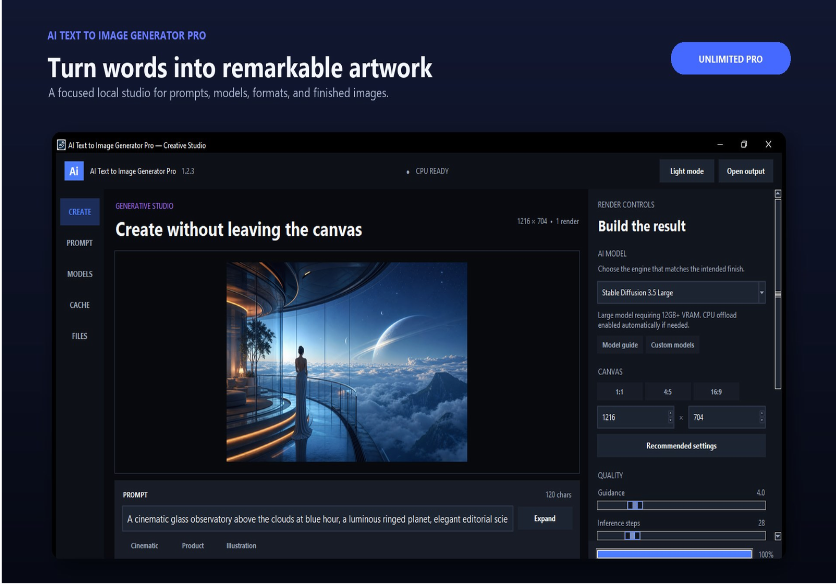
System requirements depend on the underlying AI model and how the application processes images.
Operating System
Check which operating systems are supported. A downloadable Windows application has different requirements from a browser-based AI service.
Processor and RAM
Local image generation can require substantial processing power and memory. Lightweight applications and cloud-based services may have different requirements.
Graphics Processing Unit
Some locally running image-generation models benefit from a compatible GPU with sufficient video memory. Other services perform the generation on remote servers, reducing the local hardware requirements.
Storage Space
A locally installed application may need additional space for model files, generated images, temporary data, and updates. Online services generally store much of their processing infrastructure remotely.
Internet Connection
Cloud-based image generation usually requires an internet connection. Offline use is possible only when the specific application and its models support local processing.
Always review the developer's published requirements before downloading or purchasing the software.
AI Text To Image Generator Pro Free Download
Users searching for AI Text To Image Generator Pro free download should first confirm whether the intended product is available as a desktop application or an online service.
Not every AI image generator requires installation. Some operate entirely through a website, while others provide downloadable applications or locally running models.
A legitimate download process should begin with identifying the developer and locating the official product page.
Follow these steps:
Search for the exact product name and verify the developer's identity.
Visit the developer's official website or an authorized application store.
Check whether a free version, free trial, or limited free plan is available.
Review operating system requirements and supported hardware.
Read the license terms, privacy policy, and image usage restrictions.
Download the installer only if the product provides an official installation package.
Scan downloaded files with trusted security software before opening them.
Install the application and follow its official setup instructions.
A free download does not necessarily provide unlimited image generation or unrestricted access to professional features. Some products limit the number of generations, image resolution, model selection, or export options.
Avoid unofficial installers that promise unauthorized premium activation or unlimited paid features. Such downloads can expose your computer to malware, unwanted software, or compromised accounts.
If the product turns out to be a web-based service, use its official website rather than downloading an unverified executable.
How to Install AI Text To Image Generator Pro
The installation process depends on whether the product is a desktop application or an online tool.
Step 1: Identify the Correct Product
Confirm the developer, product name, and edition. This is particularly important when multiple applications use similar names.
Step 2: Download or Open the Official Service
If a desktop installer is available, download it from the official source. If the product is browser-based, open the developer's official website instead.
Step 3: Check Compatibility
Review the operating system, hardware, storage, and internet requirements before proceeding.
Step 4: Install the Application
Run the verified installer and follow the displayed instructions. Do not bypass security warnings for files from unknown sources.
Step 5: Sign In if Required
Some AI services require an account to access generation tools. Review account permissions, privacy settings, and any payment requirements before signing up.
Step 6: Configure the Available Settings
Select the available image dimensions, generation options, or artistic styles. These controls differ between applications.
Step 7: Create a Test Image
Enter a simple prompt and generate a test image. Review the result and adjust the description to understand how the system responds.
How to Create Images Using AI Text To Image Generator Pro
Although interfaces differ, most text-to-image tools follow a similar process.
Step 1: Write a Clear Prompt
Describe the main subject and what you want the image to communicate. Add relevant details about the setting, lighting, composition, and mood.
Step 2: Select Available Settings
Choose a style, aspect ratio, or image dimension if the application provides these options.
Step 3: Generate the Image
Submit the prompt and allow the system to process the request. Generation time depends on the model, hardware, and service capacity.
Step 4: Review the Result
Check whether the subject, background, and composition match your original idea. Look for visual errors or unexpected details.
Step 5: Refine the Prompt
Change the wording to clarify the intended result. Small, focused adjustments can make it easier to determine which prompt details influence the output.
Step 6: Save the Final Image
Export the result in a supported format and resolution. Store the original prompt alongside the image if you may want to recreate or revise it later.
Best Use Cases for AI Text To Image Generator Pro
AI image-generation software can support a variety of creative tasks, depending on its features and license.
Social Media Graphics
Creators can use generated visuals as starting points for social posts, promotional artwork, and campaign concepts.
Blog and Website Illustrations
AI-generated images can help illustrate articles, landing pages, and educational content. Users should check image licensing and ensure that visuals accurately represent the subject.
Marketing and Advertising Concepts
Marketing teams can explore visual ideas before commissioning final artwork. Generated concepts can help communicate a creative direction to designers.
Digital Art and Creative Projects
Artists can experiment with environments, color palettes, characters, and visual styles as part of their creative process.
Educational Materials
Teachers and students may use generated visuals to explain abstract ideas, illustrate fictional settings, or create supporting materials for presentations.
Presentation Graphics
Generated images can provide visual context for slides and reports. Important facts, labels, and diagrams should be reviewed separately for accuracy.
Tips for Getting Better Results
The quality of AI-generated artwork often depends on the clarity of the prompt and the capabilities of the model.
Be specific: Describe the subject, setting, and important visual details.
Explain the composition: Specify whether the subject should appear close-up, in the distance, or in a particular part of the frame.
Describe the lighting: Include relevant details such as soft daylight, dramatic shadows, or warm evening light.
Choose a consistent style: Avoid combining contradictory visual instructions.
Refine gradually: Change one or two elements at a time so you can evaluate the effect.
Review details: Check faces, hands, objects, backgrounds, and any text included in the image.
Respect usage rights: Review the service's terms before using generated images commercially.
These techniques can improve prompt clarity, but they cannot guarantee a particular result from every AI model.
Advantages of AI Text-to-Image Software
AI image-generation tools can offer several benefits when used appropriately.
Faster concept development: Explore visual ideas without drawing every element manually.
Creative experimentation: Test different descriptions and styles.
Accessibility: Allow people with limited illustration experience to create visual drafts.
Flexible applications: Support brainstorming, educational content, and digital design.
Iterative workflow: Revise prompts and generate alternatives as needed.
The value of these benefits depends on the software's quality, usage limits, and the user's objectives.
Limitations to Consider
AI image generators also have limitations that users should understand before relying on them for important projects.
Inconsistent results: A prompt may produce different outcomes across generations, and certain details may be inaccurate.
Usage restrictions: Free plans may impose generation limits, lower resolutions, or restrictions on particular features.
Hardware requirements: Locally running models may need capable graphics hardware and sufficient memory.
Privacy considerations: Prompts and uploaded images may be processed by a remote service. Review the provider's privacy policy before submitting confidential material.
Commercial licensing: The right to use generated images commercially depends on the service's terms, the model, and potentially other applicable rights.
Text and fine details: Generated images may contain misspelled words, distorted objects, or other errors that require manual correction.
Understanding these limitations helps users select a tool that suits their needs.
Frequently Asked Questions
Is AI Text To Image Generator Pro free to download?
That depends on the exact product. Verify whether its developer provides a free installer, free edition, trial, or online plan. Downloading an application does not automatically make every feature free.
Can AI Text To Image Generator Pro generate realistic images?
Text-to-image systems can generate realistic-looking visuals, but the results depend on the model, prompt, and available settings. Realistic appearance does not guarantee factual accuracy.
Does it work on Windows 11?
Windows 11 compatibility cannot be confirmed from the product name alone. Check the official requirements for the exact application and version.
Does the software require an internet connection?
Cloud-based image generators generally require internet access. A locally installed tool may support offline generation if its models and dependencies are available on the computer.
Can I use generated images commercially?
Commercial use depends on the specific application's license and terms. Review the provider's rules before using generated images in advertising, products, or client projects.
Which image formats are supported?
Supported formats vary by application. PNG and JPEG are common, but you should verify the available export formats in the official documentation.
Is AI Text To Image Generator Pro safe to install?
Safety depends on the authenticity of the download and the software itself. Use the official developer's website or an authorized store, scan downloaded files, and avoid unauthorized modified installers.
Where can I download AI Text To Image Generator Pro?
The exact official download link cannot be reliably identified from the name alone. Confirm the product's developer and locate its official website or authorized listing before downloading.
Conclusion
AI text-to-image technology offers an accessible way to transform written ideas into digital visuals. Depending on the application, users may be able to explore different styles, refine prompts, generate image variations, and save artwork for creative projects.
For anyone researching AI Text To Image Generator Pro free download, the first step is to identify the exact application and verify its official source. Check its features, operating system compatibility, pricing, usage limits, and image licensing before installing or using it.
Once the correct product has been confirmed, a clear prompt and a careful review process can help you create more useful visual content for websites, presentations, social media, and other creative projects.